


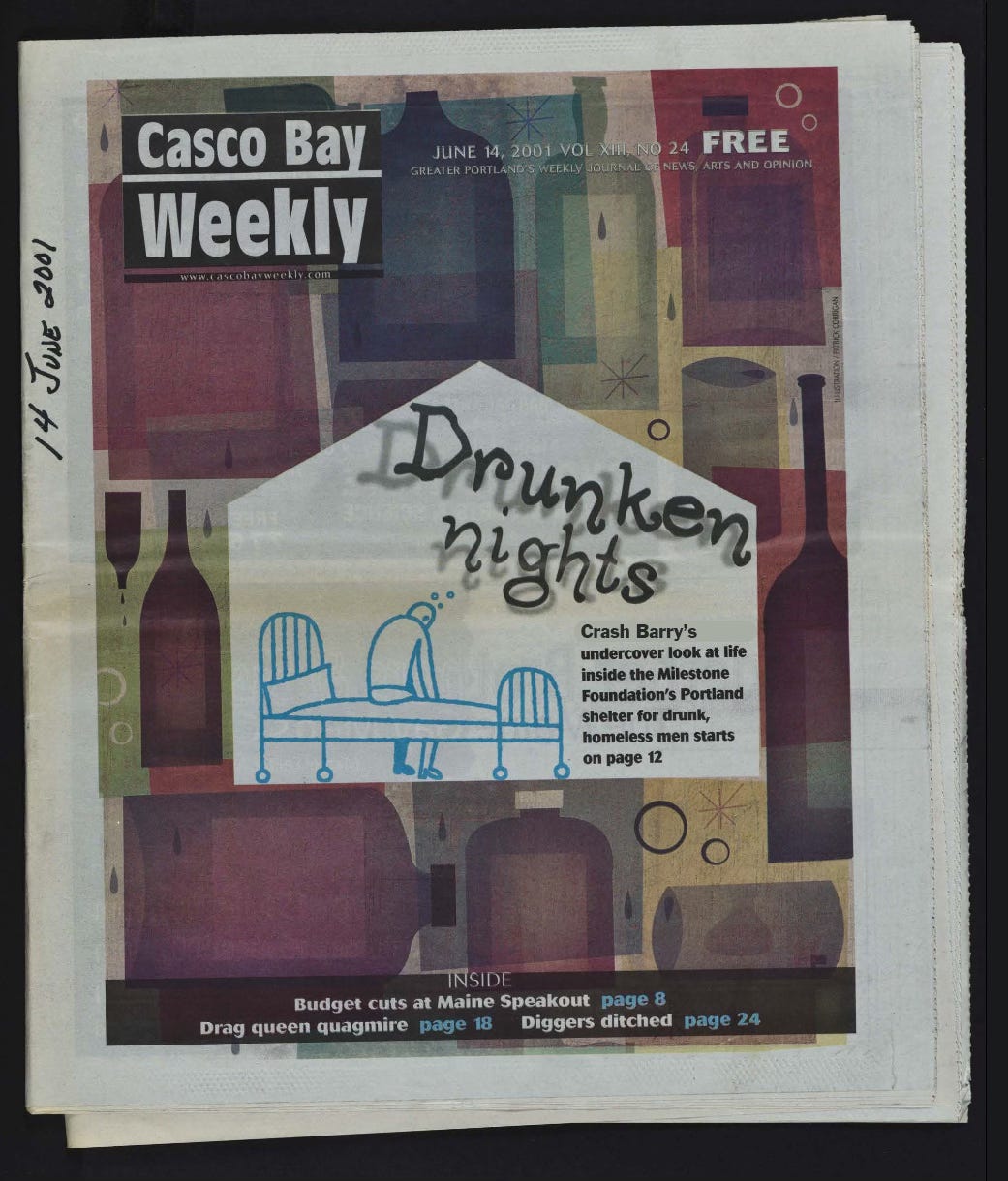
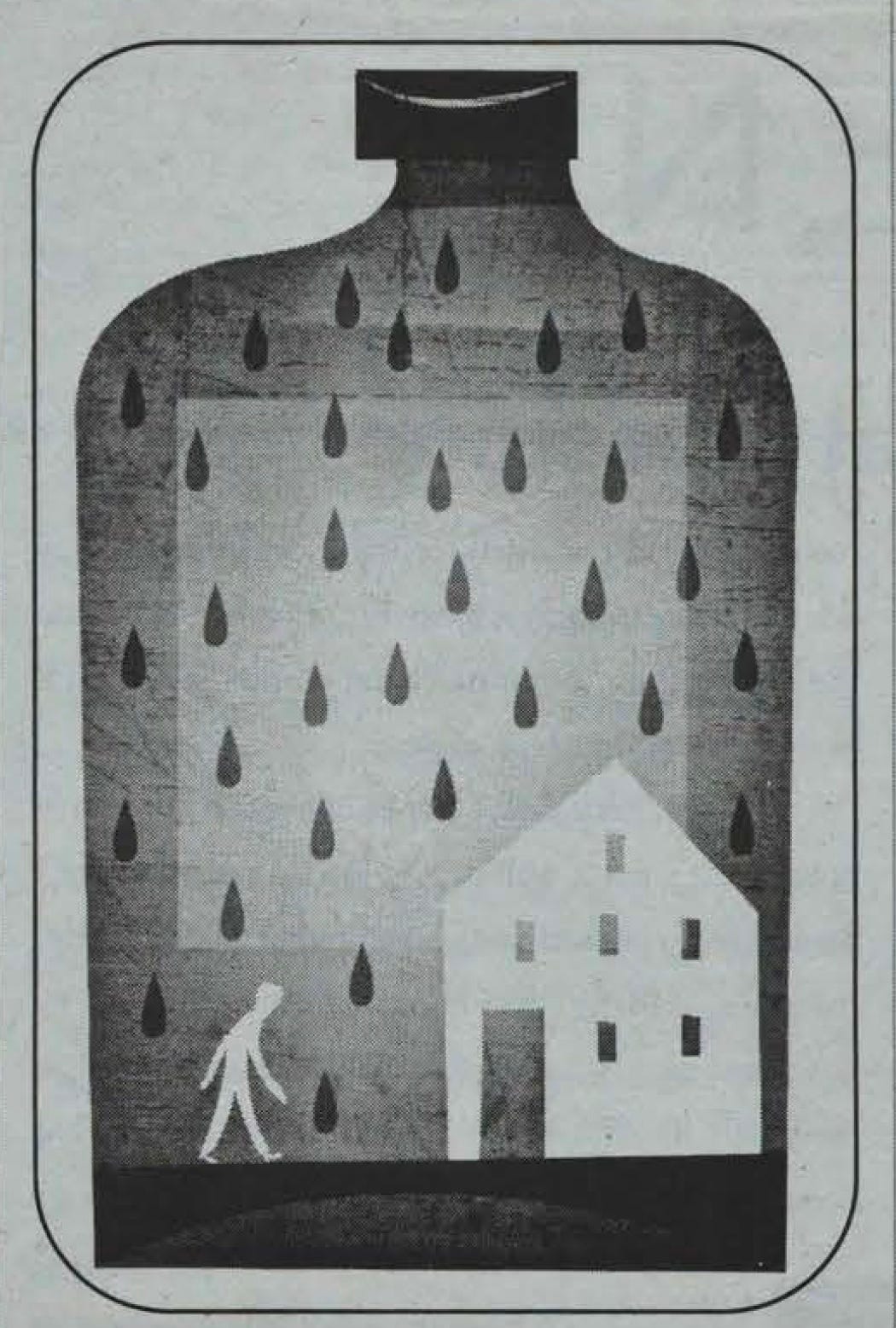
[[Author’s note: I’m up to my ears in tape for my forthcoming true crime pod Fake Shaman, so I’ve decided to re-publish some of my journalism from the pre-Internet era. This 2001 piece — illustrated by the gifted artist, musician and impressario Patrick Corrigan — visits a very sad but wonder-filled place, an emergency shelter for drunk homeless men.]]
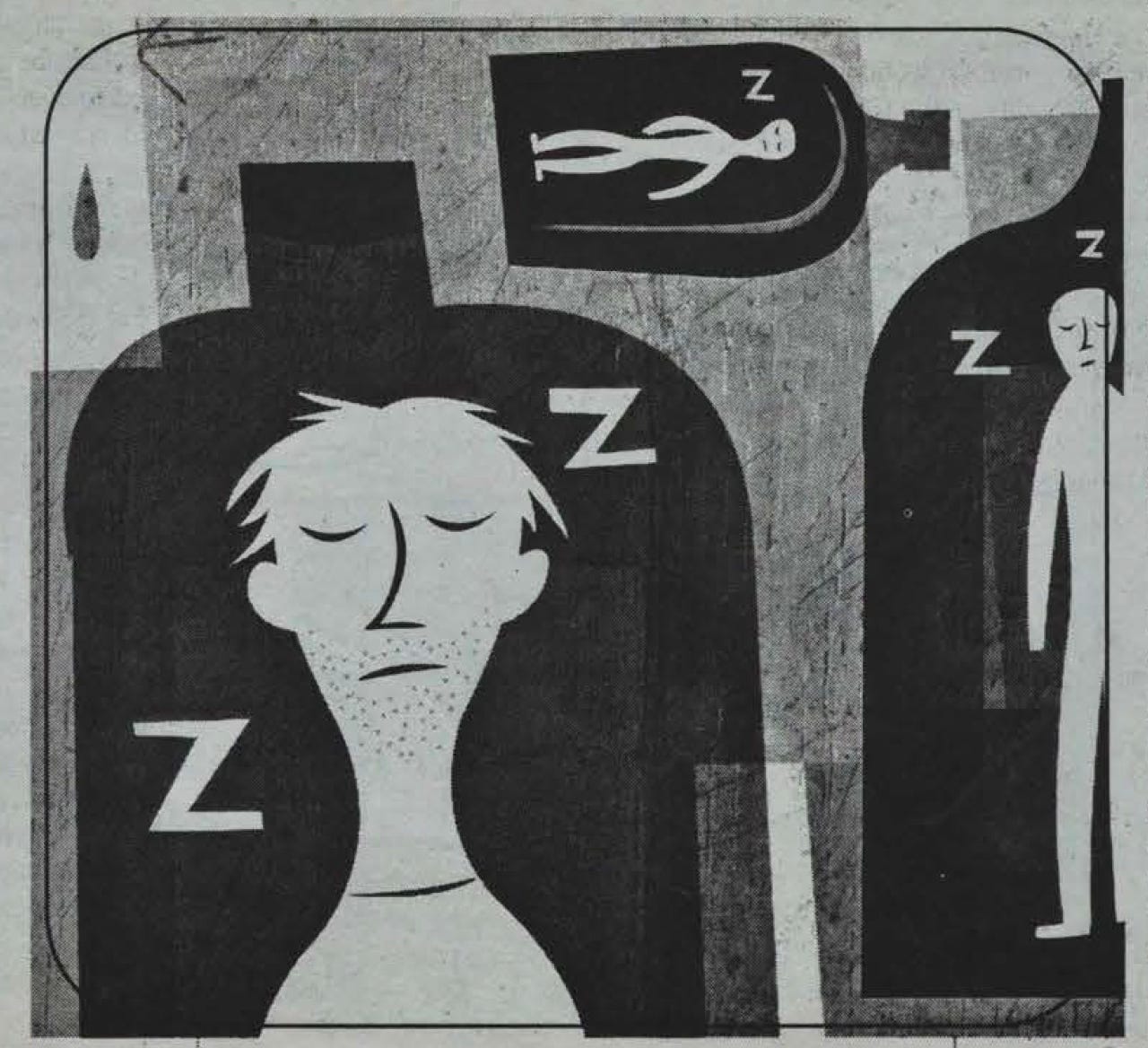
It was 1 in the morning in the basement of a Portland detox center, and I couldn’t sleep. The room stunk of booze, dirty feet and unwashed ass. A dozen men were snoring, passed out drunk on vinyl mats. It was muggy, and I was sweating my balls off. My dirty dungarees and boxers were stuck to the vinyl.
I desperately needed some shut-eye, but the cacophony of wheezes, nightmare moans and sleep-talkers, combined with the reek of flatulence, prevented me from dozing. Plus, the guy sleeping 8 inches away on the next mat kept invading my space, trying to cuddle and spoon. Perhaps he thought I was his ex-old lady, the one who threw him out of the house. I repeatedly slipped his arm off me. Finally, slumber came.
When I awoke a half-hour later, my sleeping neighbor was holding me tight. I slugged him. He awoke and immediately understood the problem.
“I’m sorry, man,” he said. He released me from his embrace, then flipped over to the loneliness of his own mat.
Welcome to “the Club.”
The Club. That’s what the guys on the street call this place, but its official name is the Milestone Foundation (formerly the Arnie Hanson Center), a nonprofit, emergency, homeless shelter for intoxicated men funded by the city, the state, some Medicaid reimbursement money and private donations. The facility is located on India Street. Every night, up to 29 drunks come to the Club to pass out.
Believe it or not, it’s a wonderful place.
I spent five nights at the Club pretending to be a drunk, homeless fisherman. A friend called the shelter to inquire if they had room and to set up my story. (I stayed there on the condition my presence would not take up the last available bed.) The guy on the phone said, “We don’t turn anyone away.”
The Club caters to one of the most difficult client populations in the world of social services: chronic alcoholics. In addition, some of these men were mentally ill. Others were depressed or had brain injuries. I wanted to see how the staff treated these clients.
Admittedly, I have a vested interest. My friend Philly (all names have been changed) has been living at the Club for most of the past 21 years. I first started hanging out with Philly six years ago, while I was posing as a panhandler for a past story, and we’ve since become good buddies.
Philly is tough to get to know. He has a head injury, the result of a drunk driver running him down one night in 1979 and leaving him for dead on the side of a road in rural Maine. His brain swelled, bulging against his skull. Twelve hours later, someone found him and brought him to a hospital. After surgery and months of treatment, he ended up on the streets of Portland.
Philly had issues with booze as a teen-ager, before the accident.
Now in his early 40s, he drinks heavily and has developed so many problems it’s hard to imagine him ever attaining normality. Even with intensive treatment and rehab, he’s too far gone. Besides, he doesn’t want to change.
He gets the first of his beers at Joe’s Smoke Shop on Congress Street around 6 a.m. For the rest of the day, he panhandles, smokes, sits on park benches, leans against buildings and drinks in alleys.Philly’s painful gait, a limp and shuffle caused by the brain injury and enhanced by years of alcoholism, translates into a slow, torturous walk. Even sober, he staggers. After six beers, he often falls.
In the late afternoon, he starts his sidewalk hike home to the Club.
The first night: There but for the grace of God
When portraying a homeless man, I strive for authenticity. My clothes are filthy, smelly and torn. I don’t shower for a week. My hair gets dirty and unkempt and I shave my beard, leaving behind a cheesy mustache. Then I grow stubble for a couple days. I also change the intonation and volume of my normal speaking voice.
Of course, I needed to be drunk for this assignment. So, before heading to the Club each night, I downed several shots of cheap bourbon and drank a couple of beers. (Don’t be jealous — alcohol is not my drug of choice.) For added effect, I poured bourbon over my head and rolled in the dirt outside my apartment. I was a mess.
I arrived at the Club on a Thursday night in May a little after 8.
Immediately, I felt welcome.
The staff was incredibly friendly, especially a man I’ll call Bullet.
He’s a short, athletic guy in his late 30s or early 40s, with a full mustache and curly hair beneath a baseball cap. Energetic and concerned, he talked to everyone. He gave me a 5-second back rub and told me I could stay as long as I needed. “Are you hungry?” he asked.
I was, but before dinner, I had to check in and register. A guy I’ll call Foley needed my information. Tall and in great physical shape, Foley is about 30 years old. He’s a kind man with a spider web tattoo on one of his elbows. While asking me the check-in questions, he kept apologizing for the delay and assuring me there would be food and a place to sleep.
I’ve had longer waits in hotel lobbies. “Been drinking tonight?” he asked.
“Bourbon,” I answered.
Foley took down my personal information. I used an alias and a fake Social Security number. He wanted to know if I was homeless (yes) and if I qualified for Social Security (no) or Medicaid (no).
Then he had a second series of questions for a confidential survey from a government agency.
How old was I when I started abusing alcohol and tobacco? Have I been arrested in the last year? Do I abuse other drugs? Have I ever used needle drugs? (16, no, reefer, no.)
The interview was briefly interrupted when Foley jumped up and quickly moved to the other room to quell a disturbance. One guy was giving another some grief. He separated the two and told them to get to bed. The guy who’d been giving the grief gave Foley a little lip. Foley warned him not to mouth off, and again told him to get to bed.
Then Foley sat back down, finished the interview and spelled out the rules. “No violence,” he said. “You fight, you’re out.” (They must be serious about that - my slugging of the snuggler was the only act of violence I witnessed.) The best time to get a bed is between 5 and 6 in the evening. The lights go on at 5 in the morning and the clients have to be out by 6 a.m. (7 a.m. during the winter). I could take a shower, shave, brush my teeth and they’d even wash my clothes while I slept.
Foley then explained how the shelter is run. A residential detox center was located upstairs. During the day, the basement is used for AA meetings, therapy and meals for the detox patients.
But at night, it’s the Club.
“If you want to talk about alcoholism, just speak up,” Foley told me. “It’s a disease, not a weakness. If you’re ever ready, let me know.” He was very gentle and not the least bit preachy.
Dinner was next. The eating area was an L-shaped counter built along the hallway leading to the front room of the basement. Bullet served me a plate of fried ham, bologna and canned green beans and yams, with a glass of milk and a couple pieces of bread. Despite my hunger, I have an aversion to bologna and yams, so those went in my pocket.
While chewing the ham - which tasted more like corned beef - my eyes adjusted to the semi-darkness. The front room has 15 hospital beds. There, in the first bed, the one closest to the wall and shadowed from the dim hallway bulb, was Philly, asleep.
I had never seen him so peaceful. He’s always leaning, staggering, stumbling or falling. But in the Club, he rests.
I went outside for a smoke after dinner, then headed to my mat in the back room. (The first 15 Club members to arrive get dibs on the beds.) It was a little past 9. I laid awake for several hours listening to the rival snores of drunk men. Nose snores, I learned, are more high pitched than mouth snores, but mouth snores are much louder.
I simply wasn’t drunk enough to sleep through the racket.
I also eavesdropped on the staff’s conversations.
They talked about baseball, mostly the Red Sox, and discussed the importance of 12-step programs and the need for a good sponsor in order to stay off the sauce.
I watched men wake up, struggle to rise from their mat, stagger to the bathroom, then return. I dozed off and my neighbor snuggled me.
Around 3 in the morning, a loud drunk began banging on the Club’s front door. He insulted and berated the staff when they told him he wasn’t allowed in the shelter. Apparently, he’d caused problems in the past and was banned. When the disturbance was over, the staff discussed the situation in hushed tones and how it could have been handled better.
As promised, the lights went on at 5 a.m. “Come on guys, rise and shine,” the staff said while picking up empty mats and throwing pillowcases and blankets into a pile by the laundry room.
I’m no stranger to early morning reveille. From my days in the Coast Guard, I recall the rude wake-ups of boot camp and drunken mornings in exotic ports of call, reeking of booze and sweat.
But early mornings at the Club are far more tragic and painful. I saw my roommates in the light for the first time. Some were old, some young. Some were bloodied. They all seemed battered and tired.
Some of them took showers, put on clean clothes and headed out to a job, but the chronic Clubbers, like Philly, blearily rubbed their eyes and slowly got to their feet, shuffling toward the coffee and doughnuts on the dining counter. There’s often a sandwich there one can grab for later, too.
A seemingly mentally ill guy I recognized from the streets stopped me on my way out. He reminded me of a thin, short version of Maine humorist Tim Sample, but with a real Down East accent and a ruddy complexion from hard work outdoors.
“Can I buy your boots?” he asked.
I was carrying my fishing boots as a prop and wearing sneakers. I told him I needed the boots for work.
“Can I buy your sneakers?”
I told him I needed them, too. Besides, my feet are much bigger than his.
Second night: Thank God it’s Friday
Foley, a homeless man and I were smoking and talking on the sidewalk in front of the shelter a little after 8 p.m. I asked Foley why he worked at the Club. “The money’s good,” he said. “And I get to help people.” His dad was an alcoholic, so he experienced the evils of liquor firsthand.
Foley’s a veteran: seven years in the Army Special Forces. He’s jokey, real and a newlywed. He doesn’t imbibe. “I’ve had booze twice,” he said. “Once in the army and once at my wedding. I didn’t finish either either drink.”
“You’re lucky,” said the homeless man. I mumbled agreement.
“You can get help,” he said. “I know it’s not easy, but you can stop drinking.” Again, he was kind and non-judgmental. My drunk colleague and I nodded, as if considering going on the wagon.
I had arrived at the shelter an hour earlier reeking of beer, sweat and bourbon. Bullet greeted me cheerfully and asked how my day was and if I wanted dinner.
I wasn’t hungry, having just filled up on free hors d’oeuvres at an art opening at the Salt Gallery on Exchange Street, but my clothes were filthy and I was hot, grubby and stinky. Bullet suggested I take a shower.
He gave me a razor, a toothbrush, a towel, a hotel bar of soap and bottle of shampoo. He handed me a hospital johnny to wear for the night while they washed my clothes. He also gave me a new shirt and convinced me to throw away my defiled (and favorite) Guiness beer T-shirt.
The bathroom and showers were well-lit and clean. After a long, hot shower I shaved - axing my mustache too - brushed my teeth and put on the johnny.
As I walked by Bullet and Foley to drop my clothes and towel off by the washing machine, one of them said, “Hey, you clean up good.”
I went to smoke. A homeless guy gave me grief about being outside bare-assed in my johnny, but I didn’t care - I was no longer dirty.
It was my lucky night. I’d arrived early enough to score a bed. Better yet, the bed was right next to Philly, who was sleeping and snoring softly.
The front room has its pluses and minuses. The beds, though also vinyl, are comfy, covered as they are by a sheet, and there’s a little more space between you and your neighbor. A major drawback, however, is the noise. The front room is the smokers’ only route to the outside. The shelter’s metal door opened and shut all night long as guys went out to have a cigarette, stumbling to and fro in the semi-darkness. Plus, perhaps due to the room’s acoustics, the snores and nightmare moans seemed to resonate more loudly than in the back room.
Again, I had trouble sleeping, but my bunkmates kept me entertained.
A little past midnight, a skinny, shirt-less, tattooed man, maybe in his late 30s, stumbled out of bed and staggered to the dining area. He picked up the gallon of milk left on the counter and, ignoring the stack of plastic cups, chugged from it heartily, wiped his lips and headed back to bed.
Thirty minutes later, an old, white-haired man got up and shuffled his way to the dining counter. He made himself a peanut butter and butter sandwich on white bread - a popular snack at the Club, probably because all three foodstuffs are left out during the night - then poured himself a glass of milk from the tainted gallon, sat down, ate his sandwich and dozed off in the chair for a quick nap before heading back to bed.
The third-shift shelter attendants make frequent rounds to count sleeping bodies and make sure everyone was still breathing.
These staffers have a tougher gig than Foley, Bullet and the other second-shifters.
Some clients left during the night. I later learned some headed upstairs to the detox center as beds opened up, but others just departed. Maybe they had an early morning job or felt the call to return to a bottle stashed somewhere on the waterfront.
In any case, the turnover sometimes made it difficult for the staff to complete the head count. Besides the disappearing clients, others would be on the toilet or outside smoking during the census. And, on several occasions, I watched clients get up to take a leak, then return to a different mat, adding to the confusion.
Yet the third-shift staffers are observant and attentive and are not easily fooled. After a head count at 3 in the morning came out wrong, an employee I’ll call Cool Man discovered an unregistered, but familiar, client in a previously vacated bed.
“Come on, Burlson,” he said. “Wake up. You know the rules. You didn’t check in.”
Burlson had evidently sneaked in while the door was left ajar for a smoker. Grudgingly, he arose and headed outside. For some reason, he didn’t want to check in. (If you miss one night, you have undergo the entire re-registration process.)
Cool Man, the only shelter staffer of color I saw, should be nominated for sainthood or a Nobel. Burlson sneaked back in again within the hour, but despite his exasperation, Cool Man remained polite and again convinced Burison to leave.
Burlson tried to sneak back in a third time, but the Snitch saw him. I’d been watching the Snitch. He was in his 30s, scrawny but tough, with bad tattoos and missing teeth. I knew his type: the brown-noser. He helped the shelter attendants stow bedding in the morning and pretended he was in a position of authority. When he saw Burlson sneak in again, he fetched Cool Man.
At that point, it was only about a half-hour before reveille, but rules are rules. In places like the Club, rules are the only way to preserve order. Cool Man woke Burlson up yet again and told him to leave. He would be welcome back the next night, but he had to leave now. Cool Man even offered him a cup of coffee and a doughnut, but Burison was quietly obstinate. Finally, Cool Man took a more edgy approach. “Burlson, if you don’t leave, I’m going to have to call 9-1-1.”
Eventually, Burlson climbed out of bed.
Cool Man got him some java and walked him to the door. Burlson didn’t return.
I had talked to Cool Man earlier. He’s savvy like a big-city mover and shaker, but he lives in New Hampshire. His most charming attribute is that he has real conversations with the fellas. For a homeless street guy, drunk and generally ignored by passersby, Cool Man’s words and attention must feel marvelous.
Third night: My god that’s a nasty rash
When I showed up around 8, there were only three vacant mats. I didn’t want to put anyone out, so I offered not to check in, but Bullet assured me I was fine. Any extras would be sent to the overflow room at the city-run Oxford Street Shelter. Besides, he said, there were a couple guys at the Club that night who weren’t inebriated, so they would be sent to Oxford Street first.
Again, I was a mess: tired, drunk, weary of drinking and exhausted because I’d slept less than four hours in the last two nights. I ended up on the same mat I’d had my first night, but this time I had a plan to make sleeping a little more bearable.
After that first sweaty ordeal, I developed a rash. Starting on my right buttock and spreading down and under toward my inner thigh and calf was a patch of painfully chaffed, inflamed, red flesh. My theory: The vinyl mat coupled with my sweaty boxers and dirty trousers resulted in an adult version of diaper rash.
To avoid a rehash of the rash, I scored a hospital johnny and stripped down naked. I covered the vinyl mat with my nearly new T-shirt, my windbreaker (with boxers in the pocket) and my jeans, which the staff had washed the night before. I then covered my bare legs with a Club-issued polyester-and-cotton-blend blanket.
It didn’t work. The faux sheets moved whenever I moved and my bare flesh still ended up in contact with the vinyl.
Clients came and went in semi-darkness. The middle-aged guy next to me left and was replaced by a longhaired, thug-type character. I dozed off occasionally and dreamed about people less fortunate than me. But even when awake, the scene was dreamlike due to my exhaustion and the dim lighting.
Philly was on the mats tonight. I’d overheard staffers discussing him. He’d come in earlier, then left, then returned several hours later. In the middle of the night, I watched Philly struggle and rise from the mat. He slowly staggered to the bathroom, nearly tipping over several times. After a long drink of water, he stumbled back to his mat, fell to the floor and was soon fast asleep.
Reveille once again came too early. The lights went on and a few of my comrades began to grumble. A man in the corner who looked like a deranged Quaker complained, “Where the fuck is a man to go at 5 in the morning?”
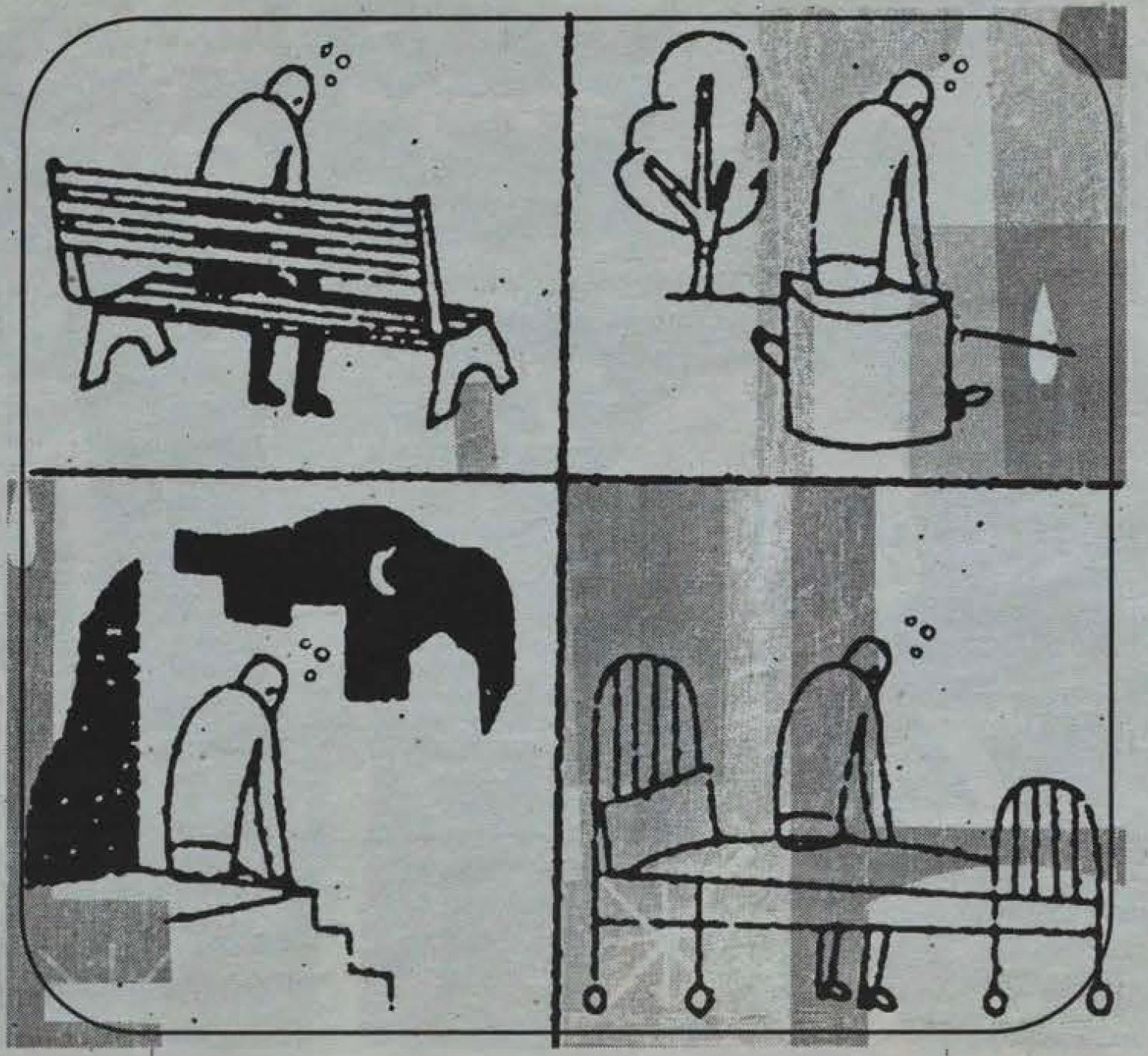
“Labor Ready,” said his neighbor. (Bad idea, as I discovered in researching an earlier story, “Take this job and shovel it,” CBW, 3.15.01.). The guys griped about how they get ripped off while working day labor. One of them said he knew a place on the waterfront that would pay cash for hard work.
“Is it me, or is it really hot in here?” asked a long-haired man.
We all agreed it was warm. One of the guys pointed out that the mats made the situation worse.
“I like sleeping on the bed so much better.” he said. “It must be the vinyl. I’m always drooling and sweating like a pig when I’m back here.”
I was about to complain about my ass rash, but an old man spoke up. He’d been around, you could tell. His face was leather, creased by wind and sun. He was hurting. It took awhile for him to get upright. “I don’t care about the sweat,” he said solemnly. “I prefer hot to cold any day.”
Philly struggled to his feet, then steadied himself against a wall. A shelter attendant I’ll call Big Guy said good morning to him. I could picture Big Guy, in his early 40s and wearing an earring, as a disco scene-maker in the 1970s. I suspect he’s a recovered alcoholic. I watched and listened as he encouraged and cared for the clients. The graceful respect Big Guy showed these homeless men was touching.
Big Guy poured Philly a cup of coffee and offered him a smoke. Philly thanked him and together they walked toward the doorway into a Sunday’s dawn.
Fourth night: Dinner with Jesus and Grandpa
Jesus and I arrived at the Club at the same time, a little past 7. He was tired, having just spent several days on the road returning to Portland after wintering down south. Jesus hoped to score a bed upstairs in the detox center, but until then, he was happy to hang out at the Club.
I’m calling this client Jesus because if the Biblical Jesus was a white man, this is how I would envision him: 5½-feet tall: long, dirty hair: a scraggly beard; a weathered face; and several key teeth missing. And this Jesus had the eyes of a savior: deep, blue, happy and omniscient. (Jesus was the only person who questioned whether I was actually an alcoholic, homeless man.) The warm, gentle smile he showed me when we learned that roast beef and mashed potatoes were on the menu could have melted even Satan’s heart.
Jesus and I were joined at dinner by a man in his 60s I’ll call Grandpa. He was also missing a couple teeth, but that didn’t stop him from devouring the meal. Grandpa had apparently helped manage the Club nearly three decades ago - he must have fallen off the wagon - and staffers had to remind him on several occasions he was no longer in charge.
Jesus and Grandpa, with their extensive experiences of such places, told me the Club is possibly the best drunk shelter in all of America. The worst ones, they said, are in Florida. You sleep on cement floors in the Sunshine State, they serve you a bowl of slop that’s supposed to be soup and talking is not allowed.
But though the roast beef was almost inedible (it reminded me of deli-sliced meat re-baked and then wiped with gravy), we laughed a lot at the Club that night. We were having so much fun, in fact, a guy trying to sleep yelled at us to keep it down.
After dinner, we all had a smoke and I retired to the same mat I’d spent two sweaty, sleepless nights on before — it was beginning to feel like home. The Club was packed, and even though there was supposed to be enough room for all those who checked in, for some reason there wasn’t any room for Jesus.
It turned out it was the Snitch’s fault. He was hammered and passed out across one-and-a-half mats. This forced his neighbor onto another mat, which threw off the arrangements.
Foley tried to wake the Snitch, but to no avail. Then Bullet got involved, but there was no moving the Snitch. After a couple minutes, they gave up.
Jesus said it was OK. He was a small guy and could squeeze in. “I’m cool,” he said. “I just need some sleep.”
An hour later, the staffers were talking to the Tim Sample doppelganger, the presumably mentally ill guy who’d wanted to buy my boots. He was complaining about his feet, how they hurt real bad. The staffers had had him take off his shoes.
I’m not sure who gasped. One of the guys got on the phone and 15 minutes later a nurse was on the scene.
“What happened?” she asked. (Hers was the only female voice I heard the entire time I was there.)
Tim Sample babbled at first, but finally it became clear his shoes were a couple sizes too small, and he’d been wearing them, wandering the streets, for a week. They’d cut gashes into his feet.
I was immediately awash in guilt. Why hadn’t I asked why he’d wanted my boots?
The rest of the night passed too slowly. The guy on the mat to my left snored and moaned the whole night. And I feared sleep, lest I dream about Tim Sample.
When the lights finally came on, I saw my moaning neighbor: He was probably in his 60s and his face was a bloody mess. A wound above his right eye was held shut by a butterfly bandage. His nose was swollen and his other eye was blackened.
I could hear Tim Sample gibbering in the other room. I wanted to see his feet. I found him sitting on a bed, slowly putting on a sock. His left foot was still bare. The top of this foot had a 3-inch gash inflamed and shiny from the nurse’s ointment.
Fifth night: The devil is in the details
On my way to the Club for my fifth and final night, I thought about how lucky I’ve been in my life. I’ve escaped death and injury so often in my 33 years that if I were religious, I’d thank a guardian angel.
What will happen when my luck runs out?
A debilitating head injury, a sudden onslaught of mental illness or a major depressive episode might turn my world upside down.
Could I end up at the Club? I’m sure none of these people planned on calling this place home.
I’d actually been considering extending my stay. I half-joked to friends about giving up my apartment and moving to the Club full time. Perhaps it was the booze or the sleep deprivation, but I was falling in love with the folks who lived and worked there.
I overheard Bullet telling one of the longtime clients that he’d gotten a new job. He was leaving the Club in a couple weeks to work as a counselor in Old Orchard Beach. My heart broke. The guys at the Club depend on him. But wherever Bullet goes, I’m sure he’ll touch and influence those in need.
I claimed the same bed I had on my second night, the one by the dining counter. I watched three guys eat that night’s dinner: pork chops, rice and string beans. One of the men was Grandpa. I didn’t know the other two, but the trio knew each other.
They talked about fellow homeless men who’d gotten “popped” - arrested, usually for public drinking or urination hauled - and hauled down to the county jail. According to these guys, being locked up and making court appearances are inconvenient, but pleasant compared to being manhandled by the cops along the way.
As fate would have it, one of the clients at dinner - a guy in his early 30s who looked like one bad-ass motherfucker - was Grandpa’s nephew. They hadn’t seen each other in months. The tough guy had apparently just gotten back to town. They reminisced about family members who refuse to communicate with them.
“I haven’t spoken to your dad in 10 years.”
“I haven’t talked to him in five,” replied the nephew.
I fell asleep listening to the family gossip. For some bizarre reason, it was soothing, and sleep came easily.
In the middle of the night, everyone awoke to the bellowing of what sounded like the devil incarnate. It was around 3 a.m., and this drunk’s voice was incredibly loud and menacing. He was another troublemaker banned from the Club. The staffers told him he wasn’t welcome and closed the locked front door.
The demon roared with anger outside. He promised to murder the attendants with his bare hands when they got off work. “I’ll be waiting for you,” he screamed. “You fucking prick bastards!”
One staffer told another to make sure the back door was locked. The Snitch got up from his bed and looked out the window.
“He’s gone,” he said.
I couldn’t get back to sleep. In those last hours before reveille, I watched the silhouettes of slumbering men and listened to their heavy, tired breathing, the coughs, the snores and the moans.
Wake-up time finally arrived and the guys got ready for another drunken day on the streets. A crowd by the dining counter grabbed coffee and doughnuts as Tim Sample babbled about a house he was going to build. At least, I thought that’s what he was saying.
Pointing at Sample, a homeless guy said, “When I understand what he’s talking about, I’ll know I’ve gone nuts.”
The crowd laughed and then slowly dispersed. I gave Tim Sample a couple smokes. He asked me if I’d ever lobstered out of Castine. I told him I hadn’t:
“Well,” he drawled in his Down East accent, “maybe you should.”
It was time to leave. Standing next to the dough-nuts, I finally found myself alone with Philly. I said his name. He looked up, looked right at me, but still didn’t recognize me. I slipped him a buck and he thanked me.
Then, for the first time during my stay at the shelter, I spoke in my normal voice. “Do you know who I am?” Philly looked confused, then, with a toothless grin, guessed “Crash?”
“Shhhh,” I said, putting a finger over my lips.
Philly began to laugh.
I walked over to Big Guy, who was putting clean sheets on the beds. Another attendant had just given him grief for not working fast enough, and Big Guy looked depressed. That was discouraging to me, as I’d watched this man perform more acts of compassion in five days than most people attempt in a lifetime.
“My boat should be here today.” I said in my real voice, “so I probably won’t be back. I just wanted to say was impressed by how kind you were to the guys. I hope you get the chance to help many other people.”
“That’s such a great compliment,” he said.
I walked away.
“A great compliment,” he repeated aloud, smiling as he made another bed. I left the Club and staggered up India Street in the early light. I got a block away from the Club before I started to cry.
At the time of publication, Casco Bay Weekly donated $250 to the Milestone Foundation to pay for my stay. For those missing the olden days of CBW’s alt-journalism, the Portland Public Library has scanned copies available: digitalcommons.portlandlibrary.com/cbw/
For seven dollars a month, (or $75 annually) you can support independent journalism that goes places other media won’t AND get early and ad-free access to episodes of Fake Shaman.

great stuff. the CBW was a wonderful newspaper. those were the days...