[[author’s note: I continue to delve into my copious archives since I’m super-busy cutting tape for the forthcoming true crime podcast Fake Shaman. Also, the woman called “Ginger” in this piece turned out to be “Sweetgrass,” the beautiful and talented human who married me, 24 years ago this week.]]
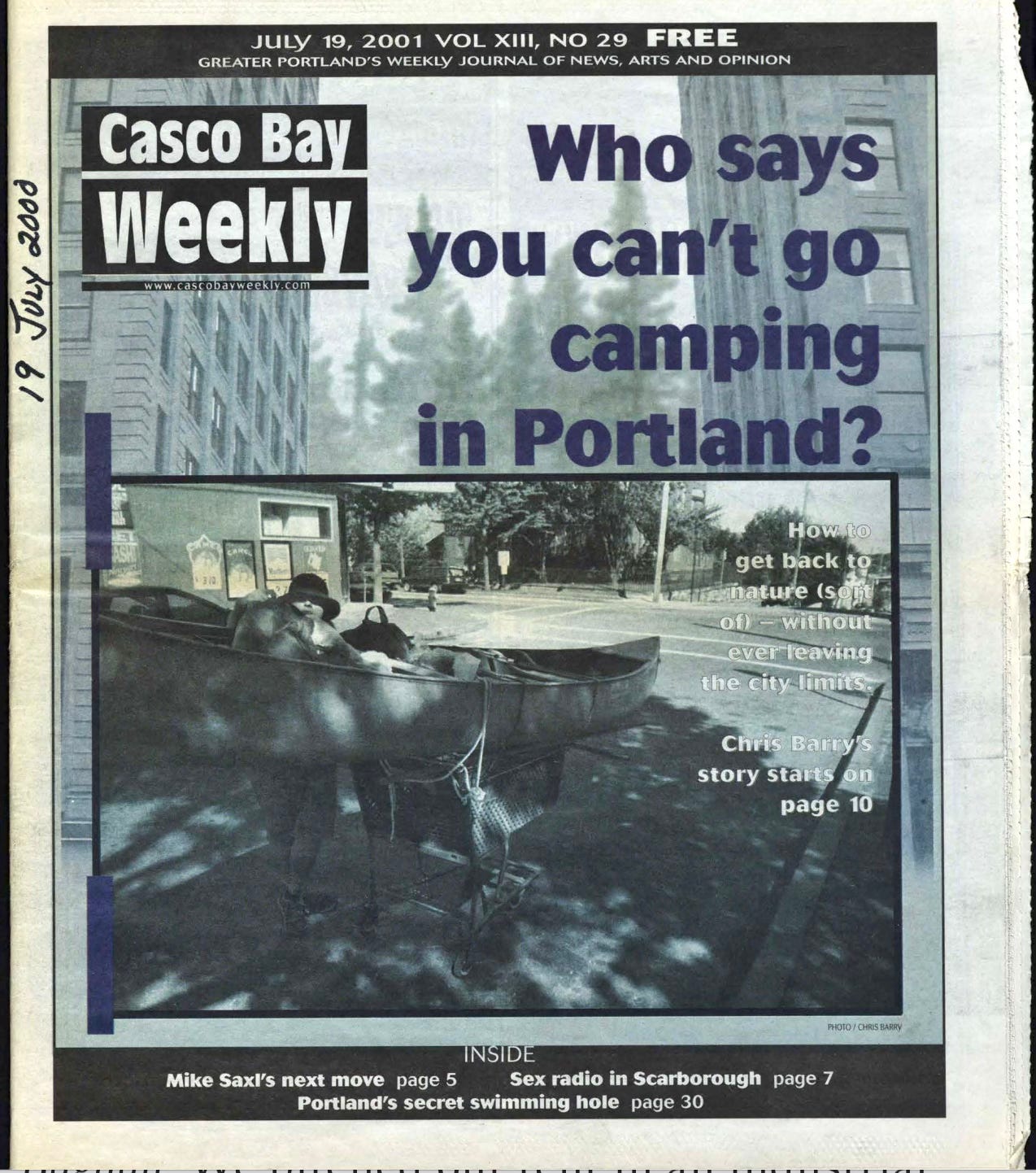
To hell with Acadia National Park, Mount Katahdin and Papoose Pond. The best place to camp in Vacationland is Portland.
My friend Ginger and I spent four days in early July exploring the city and Casco Bay on foot and aboard our canoe, the Walter Bagnall. We pitched our tent in an industrial wasteland and a wildlife sanctuary, in the shadow of an old fort and on an uninhabited island. It turned out to be the best vacation either of us ever had.
Portland wouldn’t normally be my first choice for a camping trip, particularly because I spend nearly all my time on the city’s peninsula. But it’s been a tough year financially, so we decided to have an urban adventure and make it a low-budget affair.
Although Ginger and I talked about the trip for weeks, we neglected to begin actually preparing for it until two days before we undertook the voyage. Luckily, transportation was not a problem. Several months ago, I discovered an abandoned, 15-foot, metal Grumman canoe in the basement of a building on Brackett Street. Ginger and I retrieved the vessel and lugged it three blocks to her West End apartment. We would have preferred to take the boat for a test float in the duck pond at Deering Oaks, but there was no time for such safety precautions.
We assembled all the necessary supplies for the trip in 48 hours. This included borrowing a tent and a cookstove from friends, buying food and getting our hands on two life jackets and a second paddle (the Walter only came with one).
We considered buying a paddle, but our budget didn’t allow for it. So, using a 3-foot wooden dowel and a foot-long plank, I built a sturdy substitute held together by a dozen screws and some brown duct tape. We looked into the possibility of renting life preservers, but discovered that for a mere 10 bucks, we could buy two bottom-of-the-line flotation devices.
The final hurdle was to get the Walter Bagnall from the West End to the water. (I named the canoe in honor of the first white man to settle in the Casco Bay region. After three years spent ripping off the locals and consorting with native women, he was justifiably executed in 1631.) To do so, I made a makeshift trailer by rigging a shopping cart I’d found with long metal pipes to support the boat.
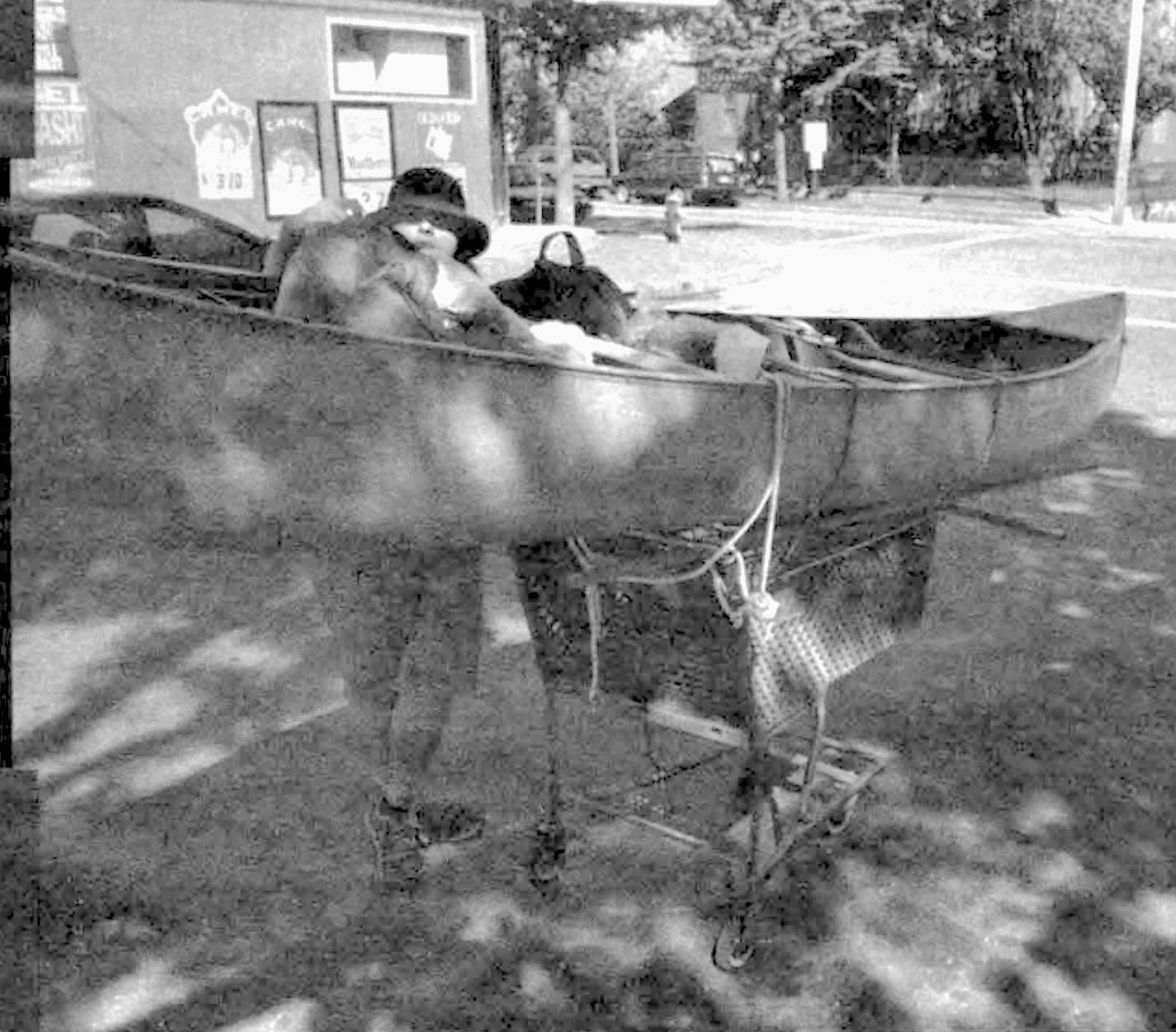
We carefully guided the top-heavy rig down the hill on Clark Street to West Commercial Street, then to a patch of land about a quarter-mile west of the Casco Bay Bridge. Pushing the ersatz trailer through the mud was impossible with the Walter on top, so we unloaded the gear and portaged the canoe on our shoulders through the woods along the Fore River, then returned to drag the shopping cart, full of supplies, to the water’s edge.
We decided to put in from an old, burned-out wharf I’d scouted out earlier. The tide was coming in, and we were planning to ride the rising water inland to our first campsite. Unfortunately, I hadn’t devised a plan to lower the canoe from the wharf to the river — a 10-foot drop. We had some rope, but Ginger and I couldn’t figure out how to avoid smashing the canoe against the huge slabs of jagged granite jutting out from beneath the wharf.
Then “Helpful Johnny” arrived. Johnny was a scruffy guy in his early 40s who rode an old 10-speed bike. He stood on the granite and pushed the boat away from the wharf as we lowered it, then gave us a hand loading the gear.
As we got under way, Ginger noticed a Portland Water District sign marking our point of departure: “Wet Weather Sewer Discharge Number 006.”
No Mercy, please
This was a working vacation. Sure, I needed to relax, but I also wanted to examine a few undeveloped areas of Portland. In plotting the course of our adventure, the first spot we planned to visit was the 30-acre stretch of land between the Fore River and St. John Street owned by Guilford Transportation Industries. Mercy Hospital is eyeing the property as the site for a gargantuan medical center.
We pointed the canoe upstream toward Merrill’s Marine Terminal and the industrial section of the river. The tide was with us, but a 15-mph head wind made paddling difficult. We worked our way past cranes, barges, tugs, oil tankers and lobster boats, sticking close to shore to take advantage of the lee of the land. After a half-hour, we rounded a bend in the river and paddled beneath the Veterans Memorial Bridge.
A word of caution: The waterborne part of this trip should not be undertaken by those unfamiliar with tides, currents and the handling of boats. Ginger grew up on Peaks Island, worked as a crew member aboard a schooner and taught canoeing to kids. I’m a Coast Guard veteran and once spent two years lobstering on Matinicus. We studied tide charts throughout the voyage and listened to weather forecasts on a portable radio to avoid any unnecessary battles with the forces of nature.
Less than an hour after putting in, we arrived at our first destination. Paddling close to the rocky riverbank - cluttered with old truck tires and other human detritus — we looked for a suitable site to land. We spotted an abandoned shopping cart and came ashore beside it, figuring it would come in handy when we lugged our supplies ashore.
We pulled the Walter above the tideline, hid her (all boats are female) in the scrubby brush and started searching for a campsite.
The Guilford land is partially wooded, with small meadows dotted with wild flowers and cluttered with illegally dumped construction debris, old railroad ties, empty beer cases, shattered glass, broken furniture, ruined couches, useless appliances and more abandoned shopping carts.
We found a grassy spot that was relatively flat and garbage-free about 50 feet from the river. Ginger and I pitched the tent, had a snack and started to prepare dinner. The menu consisted of black bean soup, a loaf of bread and a bottle of cheap red wine. After several fruitless attempts to ignite the propane stove we’d borrowed, we gave up and started looking for an alternative.
As luck would have it, I discovered a discarded gas grill. Ginger gathered wood while I cleaned the grill of several pieces of melted plastic and the remains of a hobo’s fire. Thirty minutes later, soup was on.
After dinner, we took a long and leisurely stroll through the land. If you can tune out the constant drone of traffic along Interstate 295, the frequent roar of aircraft taking off from the Portland Jetport and the ubiquitous piles of trash, it’s an idyllic setting.
The sun went down and the moon rose, nearly full. There was nary a breeze. We found blackberry bushes and the mosquitoes found us. Wildlife-wise, we spotted a few fireflies and a little brown critter that ran into the bush. Reflections of the blinking runway lights danced on the calm water. The Big Dipper shone above.
This may not sound like a great time to you — and, in retrospect, this spot was the least picturesque of all our camping locations - but being there made me question the wisdom of paving over one of the last remaining tracts of undeveloped land on the peninsula in order to build a behemoth of a building.
Mercy Hospital doesn’t pay property taxes, even though it uses city services you and I pay for. We should let Mercy move to the suburbs and turn this land into a combination dog park and summer campground for tourists, the homeless and bohemians. Such a plan could go a long way toward revitalizing the base of the peninsula.
It was time for bed. Both Ginger and I are deathly afraid of Lyme disease, so we checked each other thoroughly for ticks. It was cold and damp that night (the temperature dropped to 45 degrees) and far from quiet — the highway traffic was incessant. We slept restlessly.
Ginger awoke first and went for a walk. She discovered a small stream littered with discarded tires, which she dubbed “Tire Creek,” and spied a strange wooden structure partially hidden by vegetation.
It turned out to be a 10-foot-tall stack of ancient railroad ties. Climbing to the top, we discovered six crushed Budweiser cans and a garter snake — the first wild snake I’d ever seen in Portland - lying atop a rain-soaked pornographic magazine. I’m reasonably certain he wasn’t reading the articles. Ginger and I left “Porn Snake Hill,” broke camp, retrieved the Walter and headed back up the Fore River in search of land uncluttered by human refuse.
A Totally Natural Vacation
The second day was far more beautiful than the first. The river was calm and the sky deep blue and cloudless. Paddling was effortless.
Our destination was the Fore River Sanctuary, a wildlife preserve maintained by the Maine Audubon Society. The sanctuary, which borders the Stroudwater neighborhood, is a little more than 2 nautical miles upriver from Guilford’s property. The trip promised to be relatively simple and quick, so Ginger and I took some time to explore the waterway.
We headed up Long Creek, a tributary of the Fore River that runs between I-295 and the airport. This stretch of clean, clear water - busy with terns, red-tailed hawks and blue heron - would have been picturesque if it weren’t for all the cars and planes.
About a mile-and-a-half up the creek, we passed a sign warning us we were crossing a petroleum pipeline.The water soon changed to a murky brown and the air smelled of spray paint.
We continued upstream until we reached a dam at an underpass below Westbrook Street in South Portland, not far from the Dexter Shoe Outlet. We tied the canoe to a tree and climbed the riverbank - stopping to pick ripe, juicy raspberries along the way — then jumped a guardrail and sprinted across four lanes of speeding traffic to check out the other side of the dam.
The tide drains quickly this far upstream and we realized it was heading out, so we rushed back to the Walter and paddled madly toward deeper water for fear we’d get stranded high and dry for six hours on the wrong side of the reeking pipeline.
Soon we were relaxing again, drifting with the current and nibbling plums, barely steering. At the mouth of the creek, we headed northwest toward the Audubon property. After 45 minutes, we reached Stroudwater Crossing, where outer Congress Street passes over the Fore.
The river is less than 20 feet wide at this point. On the other side of Congress, it forms a small lagoon. This is where the sanctuary begins.
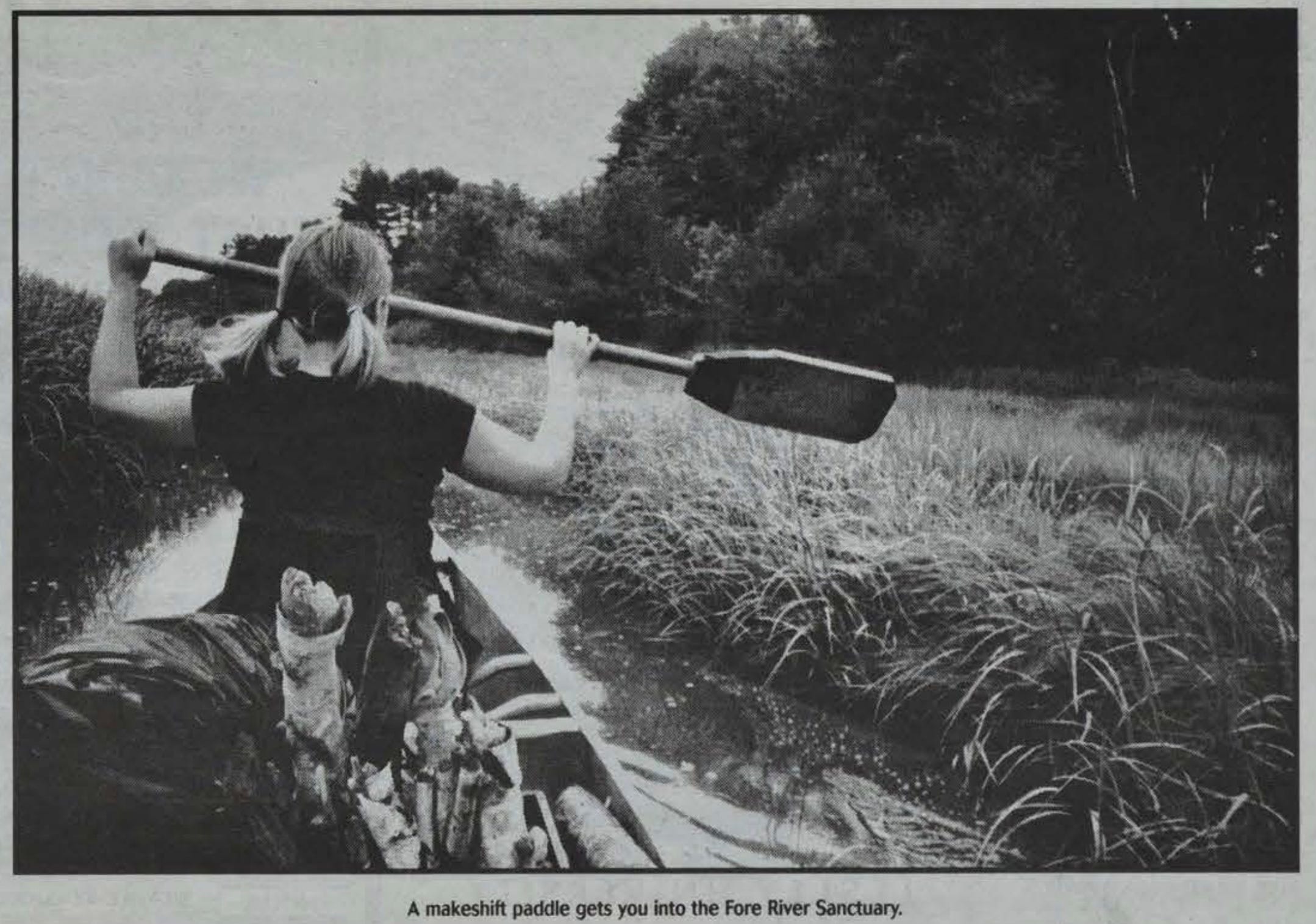
Paddling up the river - reduced to a 4-foot-wide channel meandering though swampland at this point - we were impressed by the spectacular flora and fauna. We listened to the songs of cardinals and the flute-like melody of the veery. We spotted orioles and several huge grouse that dashed for cover in the trees.
Soon, the tidal stream disappeared, leaving us aground on the muddy bottom. We hauled the Walter up onto the bank and sat on a footbridge to enjoy the view and our peanut-butter-and-raspberry-jelly sandwiches, trying all the while to ignore the ever-present hum of automobile traffic.
The preserve is one of Portland’s gems. During our stay, however, we only spotted a couple dozen people taking advantage of it. And shockingly, two of them were on motorcycles, which are forbidden there.
Bicycles, fires and pets are also unwelcome at the preserve, and camping is a no-no. Ginger and I are law-abiding visitors, so we pitched our tent in the heavily wooded backyard of an expensive house bordering the sanctuary and went searching for a suitable place off the preserve to cook dinner.
Before the meal, however, we wanted to clean up, so we visited another secret gem: Jewell Falls, Portland’s only naturally occurring waterfall. Many years ago, a young woman and I were busted in flagrante delicto there by a group of school kids on a field trip. This time I was only interested in getting clean.
I stripped naked and, using an environmentally safe soap, tried to reach all my dirty parts. My mission nearly complete, I looked up and saw a middle-aged man walking a dog across the footbridge. He was watching me with a look of disgust on his face.
My first impulse was to rebuke him for breaking the preserve’s pet rule, but then I realized my own actions were probably just as inappropriate. “Sorry, man,” I shouted to him. He scurried away.
We set up our outdoor kitchen about a half-mile from the preserve along a construction road leading to an as-yet-unbuilt development. Making a fire pit at the bottom of a hill, Ginger and I discovered a second garter snake (this one apparently didn’t care for porn). We dined hobo style (out of one pot) on spaghetti and homemade marinara, a loaf of bread and another bottle of red vino. We were having such a great time, we almost couldn’t hear the traffic nearby. After sunset, we walked back through the preserve to our tent.
Hundreds of fireflies lit the meadows and swamp, and the sky glowed with moonlight.
Back at our campsite, we checked each other for ticks again and listened to the weather forecast on the radio. It was warmer than the night before, and we were exhausted. We slept well.
Ginger and I both awoke around 7. Rather than build another fire, we headed to the Burger King on Brighton Avenue with our tea bags and mugs to bum some hot water and use the facilities, then crossed the street and purchased wine and food for our Fourth of July dinner.
Back at the preserve, we loaded the Walter and put her into the rising tide. Another word of advice: Relaunch the boat with the bow facing the ocean in such situations. The channel there is so tight, there’s no room to turn around. We learned this the hard way and were forced to back-paddle out of the sanctuary.
A Gorges Fourth
We had big plans to celebrate Independence Day.
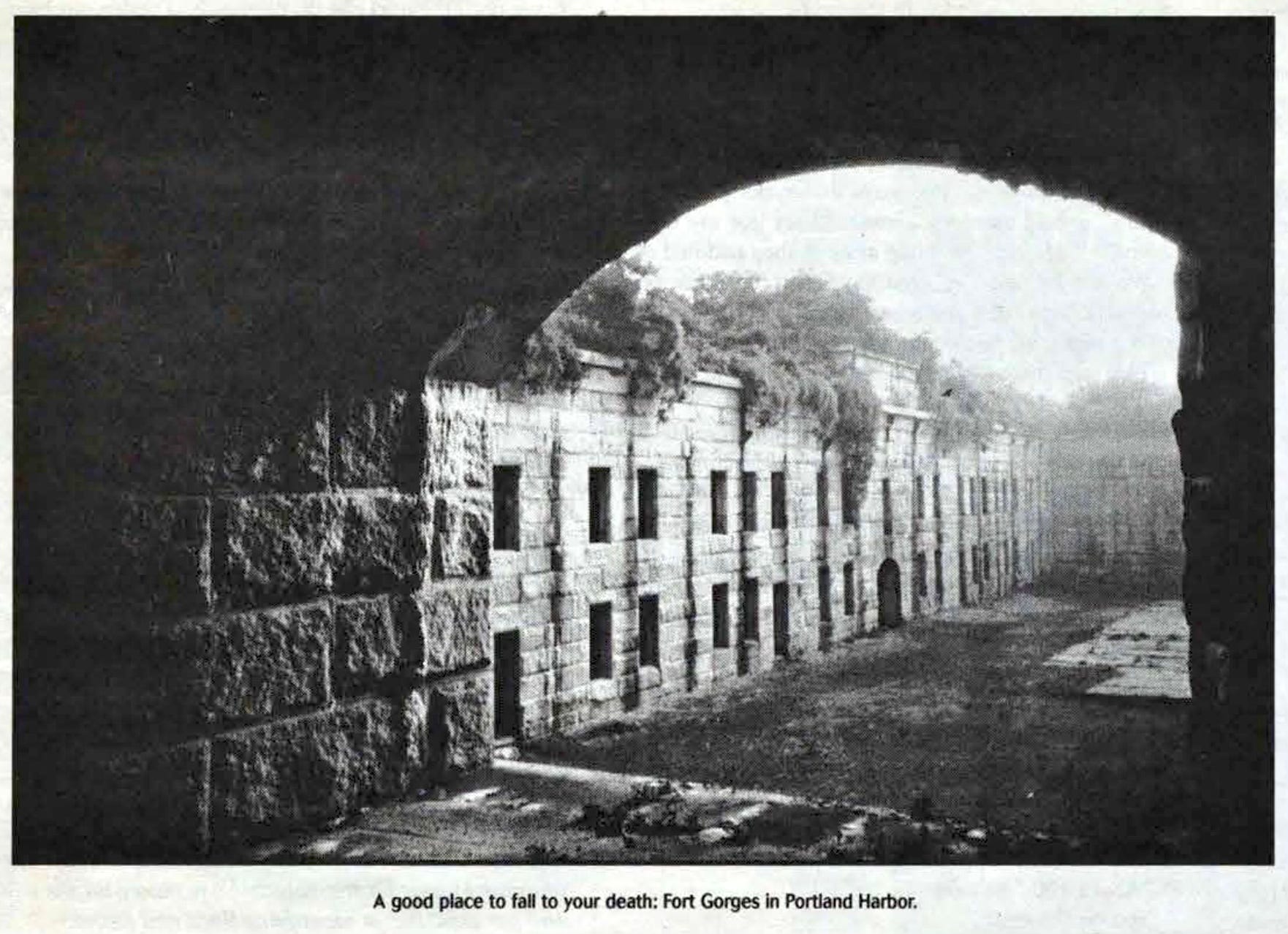
Our destination was almost six miles away: Fort Gorges, the Civil War-era citadel located on a small island off Portland’s East End. Commissioned in 1854 by then-Secretary of War Jefferson Davis - the same rogue who went on to become president of the Confederacy — the fort was outdated by the time it was completed. None of that mattered to us. We knew it would be a great place to watch the fireworks.
But first we had to get there. We paddled with the receding tide back down the Fore River and under the Casco Bay Bridge. Pulling alongside a visiting cruise ship tied up in the Scotia Prince‘s berth, we waved to the crew and passengers, then paddled past fishing wharves and slips for pleasure craft at DiMillo’s Marina, where we were almost run down by marina employees trying to move a boat to another dock. After several attempts, they finally maneuvered the yacht into its new mooring, but not before causing a floating traffic jam.
I’d made this trip many times in vessels of all sizes, but never in a canoe. Traveling so close to the water makes you appreciate “no wake” zones. It’s unfortunate many power-boaters don’t understand this concept and the fact human-powered boats have just as much right to the waterways as diesel-driven ones.
The breeze picked up and the water grew choppier as we approached the area where the river meets the sea. Stopping at the public landing next to the Maine State Pier, we stowed some unnecessary cargo (the non-working stove, a pan and some extra clothes) in a storage locker at the Casco Bay Lines ferry terminal to lighten the load, then donned our life jackets for the first time. Our plan was to follow the shore around to Fish Point on Portland’s East End, then dart out across three-quarters of a mile of Casco Bay to the fort while trying to avoid other boats and the shipping lane as much as possible.
It worked. Less than 45 minutes later, we were dragging the Walter up onto the rocky beach of Fort Gorges. And it was gorgeous. A half-dozen people who’d arrived by motor boat were also exploring the tiny island, and several others showed up in small boats and kayaks over the next few hours. Many of the mariners were drinking.
Ginger and I napped, read and wandered the grounds. Fort Gorges is an amazing place, old and mysterious, carved with dark alleyways. There are fabulous views of ocean, islands and city. It’s also dangerous — the fort offers many opportunities to fall to your death.
We eavesdropped on a boyfriend/girlfriend couple and another boy. The loner was on a cell phone calling his boss. He said he was stranded on an island and wouldn’t be able to make it to work.
A half-hour later, the cell phone rang. It was friends in a boat returning with food. When the boat arrived, a middle-aged couple and their teen-age daughter - perhaps the loner’s girlfriend — disembarked carrying bags of fast food.
Later, I found some wrappers from Subway sandwiches blowing in the sea breeze. It made me cringe.
The morons left soon after their feeding frenzy, leaving Ginger and I on the tiny island with two families who’d arrived via a pair of motorboats with enough food and Budweiser to last a week. Like us, however, they were just staying for the night.
A sign hanging above the fort’s entrance proclaimed “Enter at Your Own Risk” and “No Camping.” Again, we didn’t want to break the rules, so we pitched the tent outside the fort just above the tideline.
The others camped and carried on inside, but we couldn’t hear them on the shore. We could, however, hear a constant crashing sound as the rising tide smashed their moored motor boats against the fort’s granite walls.
I’d correctly predicted there’d be a scarcity of driftwood on the island, so before leaving the Fore River Sanctuary, I’d collected enough fallen limbs for a roaring blaze, which we built about 5 feet below the high-water mark. We cooked potatoes and corn, drank red wine, listened to the radio and watched countless watercraft head toward the Eastern Prom in search of prime spots to view the fireworks.
Around 8:30 p.m., we heard a crash and a boom. One of the power boats’ mooring lines had apparently snapped when the craft collided with the granite wall, and the vessel was drifting out into the bay. I ran into the fort to alert the beer-drinking boat owners of the situation, then ran back down to the rocky beach and dragged the skipper’s rubber raft into the water for him.
He quickly rowed out to the drifting boat, but tried to board on the wrong side — the side without a ladder - and struggled for several minutes before he was able to get on board, fire up the engine and come back. His buddy, obviously a more experienced sailor, told us this was his pal’s first time on the ocean in his boat. He usually keeps it on a lake.
We’d been enjoying illegal fireworks displays shot from the mainland and the islands all evening, but when the city’s spectacular and the show from Hadlock Field went up, our view of both was fabulous. Shortly after the grand finales, the rising tide engulfed our campfire, causing the red-hot coals to float and sizzle.
It was almost time for bed, but I convinced Ginger to venture back into the fort and play her flute. We’d forgotten to pack a flashlight, but did have candles. Our little flames flickered in a gentle breeze as we slowly climbed the stairs to the third level of the fort. Shadows from our neighbors’ fire leaped across the granite walls.
Sitting atop the eerie, old structure listening to Ginger’s haunting song, I felt as though I’d been transported to another time and place.
Back in the tent, we checked each other for ticks again, listened to the forecast and quickly fell asleep.
During the night, fog engulfed the island. I awoke around 5 a.m. and saw a white man with dreadlocks in the mist wandering along the shore toward the fort.
“Good morning,” I said through the tent screen.
“Hello,” he said, and walked away.
I went outside to look around, but there were no extra boats in sight. The white rasta wasn’t on the island the night before. Hmmm.
Jimmy the Liar
Our breakfast the next morning consisted of an apple and a glass of water. We were running out of sustenance and had burned all the firewood, which made packing quick work. With the Walter loaded, we paddled away from the fort and into the beautiful scudding fog.
The bay was flat-ass calm and the fog thickening as we made our way toward Little Diamond Island. I was worried other boats wouldn’t see us, and I’d forgotten to pack a whistle or a horn, so Ginger played a cheerful tune as I paddled effortlessly through the still waters.
The fog lifted as we made our way around the shore of Great Diamond Island, where we were struck by the number of expensive, new homes under construction.
Circling around the north end of Great Diamond, we entered another fog bank, but could see another island looming in the distance. As I’d neglected to bring a chart, this piece of land was a mystery to us.
When we stopped on a sandy beach for lunch — the last of our peanut-butter-and-jelly sandwiches — a pair of fellow canoeists from Lewiston informed us it was Cow Island.
Formerly owned by a Hollywood millionaire who let folks camp there for free, Cow is in the process of being sold to a group of nonprofits for use in educational programs. Less than a half-mile long, the island’s front side offers great views of Portland, Falmouth and Casco Bay. Its back side overlooks Long Island and Hussey Sound, and also boasts an impressive string of World War Il-era military installations. The underground spaces beneath these structures are cool and dark in the summer, and the tops of the forts are ideal for camping, provided the off-shore breeze isn’t blowing too hard.
We circumnavigated the island before putting ashore at a beach to explore on foot. It was too windy to camp on the back side, so we got back in the Walter and paddled around to the front looking for a suitable spot.
The one we found was heaven: a grassy cliff about 10 feet above a rocky beach, surrounded by a stand of birch trees. It was everything we could ask for in a campsite: privacy, an exquisite view, a ready-made fire pit and plenty of fallen wood. Ginger and I lit a blaze that lasted for eight hours. Meanwhile, we napped, played cards and listened to the radio.
Dinner consisted of the last of our potatoes and corn and tea — all the wine was gone. A brief shower - the only rain during our trip — sprinkled us while we ate. After dinner, we went on a sunset paddle, then returned to the fire and checked each other for ticks.
Shortly thereafter, two guys in kayaks passed by. “Fuck,” one of them exclaimed. “They got my damn campsite!” He kept swearing at us as they paddled off.
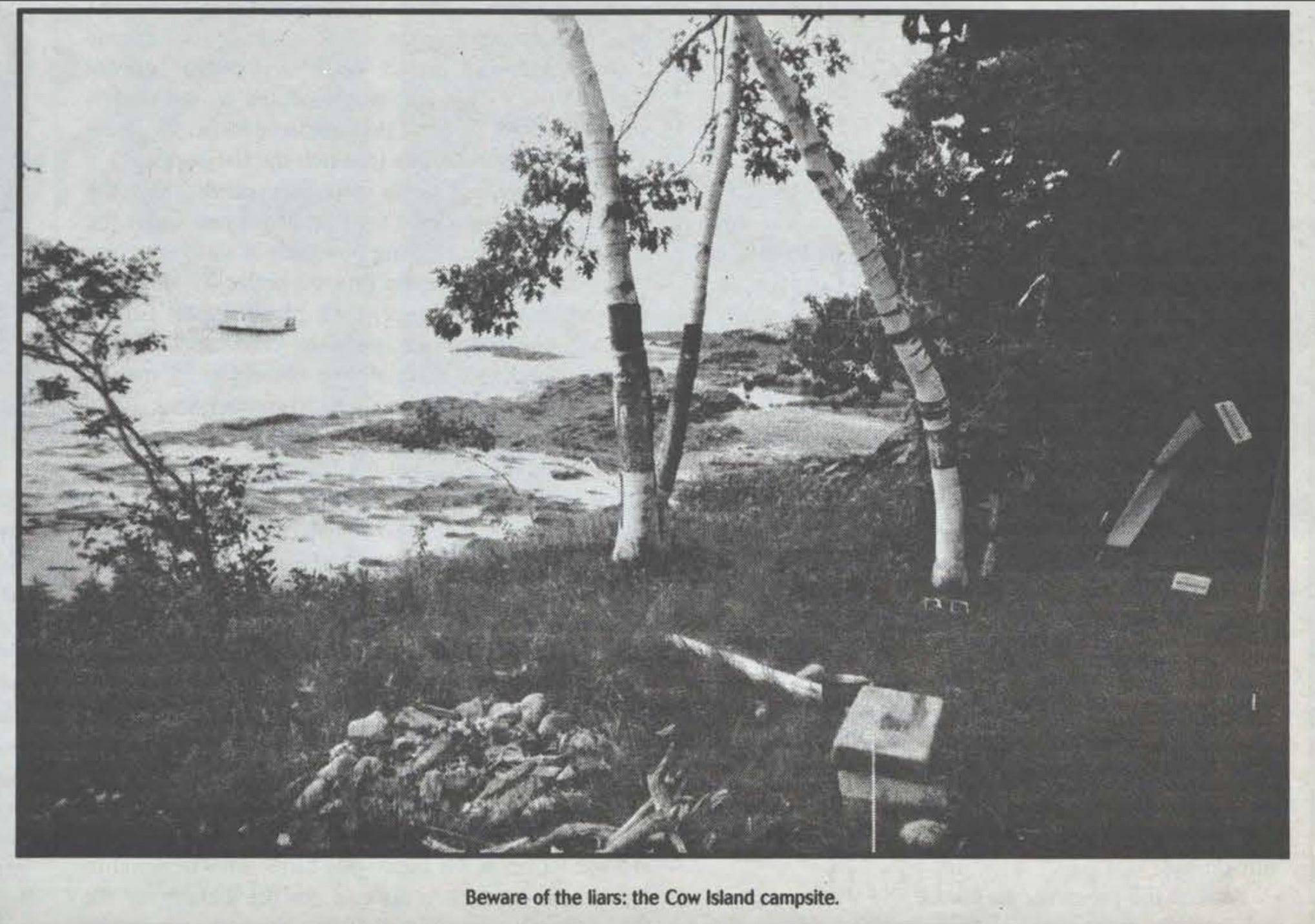
We sat by the fire, waiting for it to burn out.
Darkness came, and just when we were about to retire for the night, we heard trampling in the brush.
Two men, both wearing headlamps, appeared. Both were drunk.
The older man, Jimmy, was in his mid-40s. He sat down beside me and immediately made himself at home. Jimmy told us he’d built the site, but he didn’t mind us using it. He introduced the younger man as his son, but for some reason, that didn’t ring true.
In fact, nothing Jimmy the Liar said sounded true.
For example, he told us of a party he’d hosted on Cow Island a couple years before.
“We had 40 big pigs,” he bragged, “and 50 cases of chicken, 50 kegs of beer and 40 cases of wine. We picked up girls from Old Port bars and brought them out to the island. Damn, that was a great party. The day after, all these beautiful girls in bathing suits were trying to hitch a ride back to the mainland.”
“How many people came to the party?” I asked.
“About 100,” he said.
You do the math.
We’d soon had enough of both of them, but Jimmy kept telling tall tales and adding logs to the fire to extend his stay. After an hour, I stood up and told him we were tired and had to get up early the next morning.
“I do, too,” he said, crushing his empty Budweiser can against his forehead before throwing it into the fire.
He and his “son” finally departed, but we didn’t discover until the next day that Jimmy had stolen our camera. (Thankfully, he only made off with the last of several rolls of film I shot during the trip.)
We slept well that night. Cow Island was the softest and warmest of all our sites.
When we awoke the next morning, the wind was still quite strong. We needed to return to Portland, but I questioned the wisdom of crossing so much open water under such conditions.
We eventually decided it’d be most prudent to head over to Great Diamond Island, hide the Walter and take the ferry back to Portland. We were disappointed, as we’d both wanted to paddle home, but when we embarked at low tide, the breeze disappeared. I suggested we make a shot at the Eastern Prom. Ginger agreed.
We paddled at a leisurely pace for about an hour, stopping occasionally to watch seals and other wildlife, reminiscing about the great time we’d had. We made plans for a big breakfast. We landed on East End Beach without incident. As we prepared to return to the world of eggs and civilization, we covered the canoe with dead leaves, hiding it for retrieval at a later date.
“Walter Bagnall was a bad man,” I said as we bid our vessel goodbye. “But she’s a good boat.”
Update: One year after our adventure, Sweetgrass (aka Ginger) and I returned to Fort Gorges to get married.
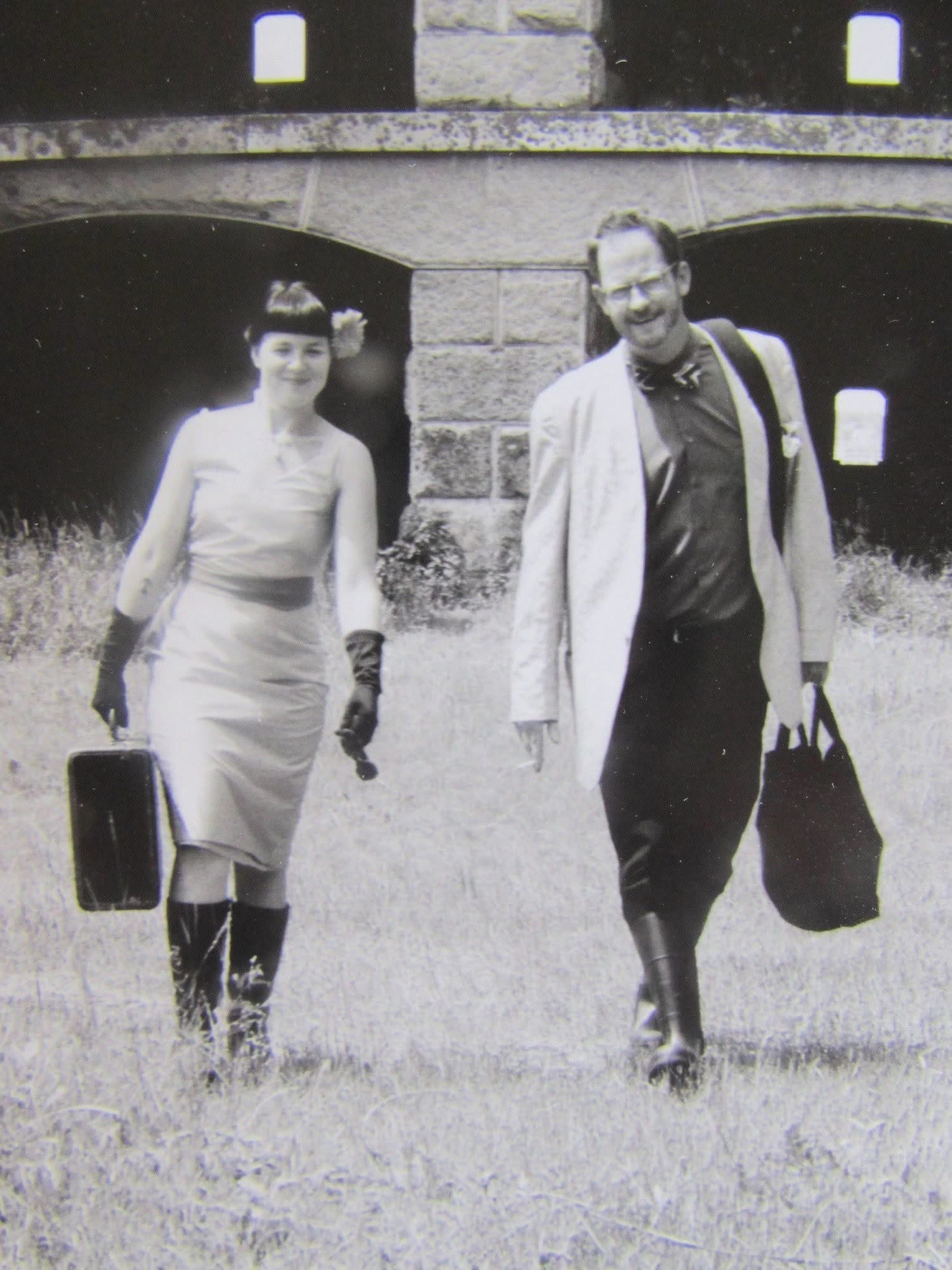
And these days, almost a quarter century later, we live in western Maine, on a farmstead in the woods, with nine goats, three pigs, 14 hens, one cat and two dogs… a long way from Fort Gorges, for sure.
For seven dollars a month, (or $75 annually) you can support independent journalism that goes places other media won’t AND get early and ad-free access to episodes of Fake Shaman.